Monday, October 25, 2010


Thursday, October 21, 2010
It’s my birthday
21st October 2010
Today is my birthday. Yes! It’s my birthday. This exclamation mark is not of extreme contentment, but displeasure and shock. It’s my birthday and I’m not happy. The day that makes one happy in absolute terms, that is, when one isn’t happy not because others are happy, is not working out for me. I don’t know but this is it. It hasn’t been like that some 365 days ago. What I’m experiencing is a revolution in my brain – a social change.
It would seem a cliché if I say that things have taken a ‘U’ turn. Technically, it’s an ‘O’ turn for me: I’m back to where I started – a little boy born in some odd corner of the world where he don’t know anyone, not even his parents, let alone friends. This mental revolution has me at its epicenter with emotional outbursts shattering the foundation of my “re-socialisation”.
Maybe, it’s because I’ve decided to make things this way. It’s not the time to blame anyone and pin-point anyone.
The end is inevitable. It has to come sometime or the other. Realising the ends and living under this definition has become synonymous with my current life-style. In between the land and the sky, I find myself trapped. It’s not that I’ve found myself trapped, it’s because out of crores I’ve felt that I’ve been trapped. One day I shall merge in the land and reach the sky. It’s a dreadlock.
Sunday, October 10, 2010
Indo-US Nuclear Deal – A Brief Overview

Introduction
The Indo-U.S. civilian nuclear agreement, also known as the Indo-U.S. nuclear deal, refers to a bilateral accord on civil nuclear cooperation between the United States of America and the Republic of India. The framework for this agreement was a July 18, 2005 joint statement by Indian Prime Minister Manmohan Singh and then U.S. President George W. Bush, under which India agreed to separate its civil and military nuclear facilities and place all its civil nuclear facilities under International Atomic Energy Agency (IAEA) safeguards and, in exchange, the United States agreed to work toward full civil nuclear cooperation with India.
Why India needs Nuclear energy?
Today, India has an installed capacity of 4.5 GW which accounts for 3 percent of the total electricity generated. The demand for power is projected to stand at about 350-400 GW by 2020 and nuclear power generation capacity is expected to increase to about 35 GW. India targets to achieve 25 percent electricity production from this source by 2050. It would be baffling to mention that France, at present, generates 78% of its electricity from nuclear power plant.
Besides, nuclear power is a clean source of energy. Amazingly, 1 GW of power station would consume roughly 3.1 million tonnes of black coal each year as compared to only 24 tonnes of enriched uranium.
However, the merits of nuclear power cannot mask the grave risk involved in harnessing that power, which could result due to mishandling of nuclear material or a fault in the nuclear reactor.
Criticisms
The bill – Civil Liability for Nuclear Damage Bill 2010 – had come under criticism from the opposition parties in India in the following ways:-
1) Claiming that it was designed to serve one-way interest of the US. Several amendments were then being suggested in the Nuclear Liability Bill, in which a major dilution being: recovery of damages from a supplier — even in the event of gross negligence — contingent upon his prior acceptance of liability in a written contract.
2) The original version of the amendment had come under sharp criticism from the BJP and Left parties as it provided for the “intent” of a supplier of causing an accident if an operator were to claim compensation.
3) The operator will be NTPC, a government run power corporation. It is contended that it will supply electricity at state subsidized rates, which ultimately would be borne by the taxpayers. In addition, only the operator can take the recourse from the supplier, in which case its financial liability would be only 500 crores (with an upper limit of 2000 crores that has to be borne by the taxpayers), which is far less than the damaged that can be caused. Ultimately, it is the indian taxpayer who will have to give the money even when the accident has occurred due to others’ mistake. The liability cap on the suppliers has been fixed at 1500 crores.
4) Clause 18 of the bill limits the time to make a claim within 10 years, which is very less as compared to the long term damage that may be caused.
Thus, the government restored the operator's right to seek compensation from the supplier and approved the draft bill with 18 amendments on August 25 2o10 in deference to the demands made by the Opposition. With the removal of “and,” the operator was free to pursue the supplier and he could do so even if there was no separate contract between the operator and the supplier.
Why so much criticism?
Though the technological developments in nuclear reactors have reduced the probability of a serious nuclear catastrophe, the Bhopal Tragedy (1984) has taught the government – the ruling and the opposition – to circumspect any other agreement that involves the masses.
Image Courtesy: http://www1.sulekha.com/mstore/newsblogs/albums/default/Indo-us%20nuclear%20deal.jpg
Saturday, October 2, 2010
AFSPA (A Brief Overview)
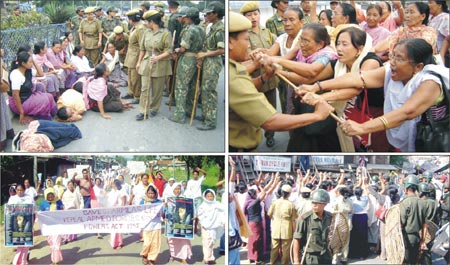
AFSPA
INTRODUCTION
The Armed Forces (Special Powers) Act (AFSPA), was passed on September 11, 1958 by the Parliament of India. It conferred special powers upon armed forces in what the language of the act calls "disturbed areas" in the states of Arunachal Pradesh, Assam, Manipur, Meghalaya, Mizoram, Nagaland and Tripura. It was later extended to Jammu and Kashmir as the The Armed Forces (Jammu and Kashmir) Special Powers Act, 1990 in July 1990.
According to the Armed Forces Special Powers Act (AFSPA), in an area that is proclaimed as "disturbed", an officer of the armed forces has powers to:
"Fire upon or otherwise use force, even to the causing of death, against any person who is acting in contravention of any law" against "assembly of five or more persons" or possession of deadly weapons.
To arrest without a warrant and with the use of "necessary" force anyone who has committed certain offenses or is suspected of having done so
To enter and search any premise in order to make such arrests.
It gives Army officers legal immunity for their actions. There can be no prosecution, suit or any other legal proceeding against anyone acting under that law. Nor is the government's judgment on why an area is found to be "disturbed" subject to judicial review. The shooting of an unarmed individual and the killing of a person in custody are not the act permissible under AFSPA.
It was withdrawn by the Manipur government in some of the constituencies in August 2004 in spite of the Central government not favouring withdrawal of the act.
The Act has been employed in the Indian administrated state of Jammu and Kashmir since 1990
CRITICISM
AFSPA has come under criticism because of the human rights abuses that have come to be associated with its operation.
The protests in Manipur reached a crescendo because of the death in custody of Th. Manorama an scores of others like her. The agitation in Kashmir inflamed because of fake encounter incidents like Pathribal and Macchhil.
A civilised society expects that the use of deadly force by the army must be at all times be lawful, necessary and proportionate. Here the act suffers from two infirmities: the requirement for prior prosecution comes in the way when question arises about the lawfulness of particular actions. Second, AFSPA doesn't distinguish between a peaceful gathering and a violent mob. Firing upon the latter may prove to be justified, shooting into the latter would fail the test of reasonableness.
CONCLUSION
A government which has faith in the actions of its officers and the robustness of its judicial system ought never to shy away from allowing the courts to step in where doubts arise.
The act can be amended so as to prevent prosecution against any person in exercise of powers conferred by this act where the Central Government provides in writing and competent courts uphold the legal validity of these reasons. Such a provision would prevent good officers from being prosecuted while allowing bad apples to be prosecuted for their crime.
Saturday, September 4, 2010
MAYA
“As we shed worn out clothes and wear new ones, the same way the soul sheds worn out bodies and wear new ones.” – The Gita

Sandwiched between the land and the sky
I shall teleport to another world
from a place that wasn’t mine
to a land that eternally shines
These are definitely not the colours
that I see with my bloody eyes
they are a part of an illusion – a pigment
that has inevitably bounded my vision
The reality begins when I sleep
in a world that has my destiny – and ecstasy
don’t, please don’t sabotage my dreams
coz I ain’t meant for this brutality
I’m yearning for that big day
when the sky will be grey
where blackness will envelope me
and whiteness will bring reality
Until then it’s my sole duty
to respect the illusion as it is
to take care of the relationships
that have their origin from celestial space
Image source :http://www.salagram.net/not-the-yuga-dharma-a-little-pierced.jpg

Wednesday, March 31, 2010
My Instincts

As the realisation dawns
that it’s beyond the ken of my instincts
the explicit, inexorable tendencies
it grips my feelings that were once free
Waiting to break-free and let loose
from the shackles that can’t amuse
the sun rises, the moon shines, the birds chirp
for the ones free, but unfortunately not me
In the day’night’, I relocate my consciousness
that makes me dizzy, topsy-turvy
in everlasting night, I might look bright
seeing myself in mirror, I say it’s sunlight
They serve me with food, water but no air
although it now seems, that I hardly care
as who will care if I’m choked and dead
or die eating this stale food and contaminated water
One thing that I consider is my last wish
to take care of her for all her life
it’s not because of her that I’m here
it’s for her that I hold on to my instincts
Image URL: http://www.believeallthings.com/wp-content/uploads/2008/12/josephsmithinlibertyjailbygregolsen.jpg
Sunday, March 21, 2010
I Have Actually Lost You

When I look through the open window
I see every colour but not green
the wind smacks my face hard
to make me realise that there’s a soul in my heart
when birds – red, brown, yellow, white - chirp
in my head, an outcry bursts
the rainbow in the sky shows me the colours in life
life - what a lifeless life
nothing seems to entertain my jaundiced eyes
when I know that I’ve actually lost you
When I look through the door
people are busy with their ‘lifeless’ life
mingling with each other with a façade
it’s an indication of a war- a hunt for one’s life
the world seems devastatin’ than ever
it’s soon going to end without a shiver
we’d decided that when ends meet
we shall ‘apparently’ be together
I’m where I was an year ago: Waiting
when I know that I’ve actually lost you
When I walk past the doorway
‘They’ welcome me to their clan
the panoramic view takes me no further
than to feel to diffuse into the sky
what the difference then would it be be
between ‘they’ and unfortunately, me
was it this difference that annoyed you?
or was it you who wanted to just move on?
what I take from you are those memories
because I know that I’ve actually lost you
Subscribe to:
Posts (Atom)
