AFSPA
INTRODUCTION
The Armed Forces (Special Powers) Act (AFSPA), was passed on September 11, 1958 by the Parliament of India. It conferred special powers upon armed forces in what the language of the act calls "disturbed areas" in the states of Arunachal Pradesh, Assam, Manipur, Meghalaya, Mizoram, Nagaland and Tripura. It was later extended to Jammu and Kashmir as the The Armed Forces (Jammu and Kashmir) Special Powers Act, 1990 in July 1990.
According to the Armed Forces Special Powers Act (AFSPA), in an area that is proclaimed as "disturbed", an officer of the armed forces has powers to:
"Fire upon or otherwise use force, even to the causing of death, against any person who is acting in contravention of any law" against "assembly of five or more persons" or possession of deadly weapons.
To arrest without a warrant and with the use of "necessary" force anyone who has committed certain offenses or is suspected of having done so
To enter and search any premise in order to make such arrests.
It gives Army officers legal immunity for their actions. There can be no prosecution, suit or any other legal proceeding against anyone acting under that law. Nor is the government's judgment on why an area is found to be "disturbed" subject to judicial review. The shooting of an unarmed individual and the killing of a person in custody are not the act permissible under AFSPA.
It was withdrawn by the Manipur government in some of the constituencies in August 2004 in spite of the Central government not favouring withdrawal of the act.
The Act has been employed in the Indian administrated state of Jammu and Kashmir since 1990
CRITICISM
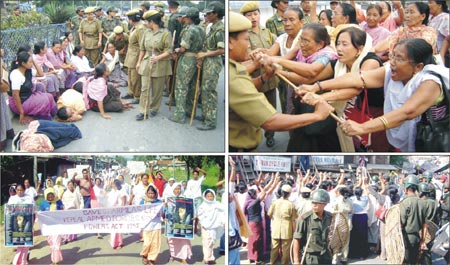
AFSPA has come under criticism because of the human rights abuses that have come to be associated with its operation.
The protests in Manipur reached a crescendo because of the death in custody of Th. Manorama an scores of others like her. The agitation in Kashmir inflamed because of fake encounter incidents like Pathribal and Macchhil.
A civilised society expects that the use of deadly force by the army must be at all times be lawful, necessary and proportionate. Here the act suffers from two infirmities: the requirement for prior prosecution comes in the way when question arises about the lawfulness of particular actions. Second, AFSPA doesn't distinguish between a peaceful gathering and a violent mob. Firing upon the latter may prove to be justified, shooting into the latter would fail the test of reasonableness.
CONCLUSION
A government which has faith in the actions of its officers and the robustness of its judicial system ought never to shy away from allowing the courts to step in where doubts arise.
The act can be amended so as to prevent prosecution against any person in exercise of powers conferred by this act where the Central Government provides in writing and competent courts uphold the legal validity of these reasons. Such a provision would prevent good officers from being prosecuted while allowing bad apples to be prosecuted for their crime.


0 comments:
Post a Comment